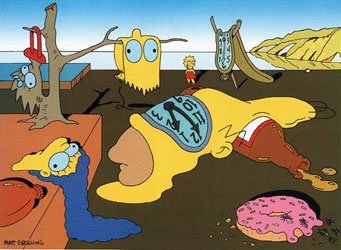
In today’s world, it seems that everything that exists in reality also exists in a virtual form. We can talk to each other in person, or talk to virtual representations of each other. We can listen to music live, emanating from physical instruments, or we can listen to an mp3, something that is pretty much intangible. This concept is a good indicator of the era that we are currently in—the postmodern era. Chapter eight of the Practices of Looking attempts to explain this postmodern era and describe its interaction with modernism.
According to many critics, postmodernism came into being in the years after 1968, in order to describe “cultural logic of late capitalism” that came in the post war years. (p 311). Postmodernism is considered to be a response to modernism, but they are often interwoven. The Practices of Looking distinguishes between the two stating that “Whereas modernity was based on the idea that the truth can be discovered by accessing the right channels of knowledge to arrive at structural and material bases, the postmodern is distinguished by the idea that there is not one but many truths and that the notions of truth are culturally and historically relative constructions.” (p 313) Overall, the main driving force behind postmodernism is authenticity.
This chapter explains how hard it is for anything to be authentic and original these days. Every story line has been done before, every song has already been written. One way that producers of media have tried to avoid being redundant is by working references to things done in the past into their own work. With the abilities presented by digital technology, it is easy to “remix” culture; bringing old ideas and combining them with newer ones. For example, the 2001 movie Shrek takes all the typical ingredients of a fairytale and combines them with multiple pop culture references to create a satire of story telling. Meanwhile, the movie continues to entertain by providing the audience with a fairytale love story. While we all have seen handfuls of princess stories thanks to Disney, we have never seen a more clever way of presenting one. When making references to other movies such as The Matrix, Shrek provides a prime example of what is known as “intertexuality”, or “the insertion of part of one text, with its meanings, into another.” (p 321). This idea important to postmodernism, where it is all about “citation or quotation both in terms of referencing other texts and in terms of putting things in quotes to indicate a kind of distancing irony.” (p 321). By making reference to another text, a link is created between the two, and when the viewer in two or more texts at a time, a deeper emotion is evoked. In many instances, there is a large gap of time between the two texts. This allows for “a re-evaluation of, and a dialogue with the past in light of the present.” (p 332). This can allow for new thoughts to be brought up about old ideas and is a very powerful tool in postmodern media.
Another important aspect of postmodernism is reflexivity. In reflexivity, the text makes reference to its own production, showing the intentions of the artist or producer in hopes of sending a stronger message. The chapter provides the example of the photography of Cindy Sherman, who operated on both sides of the lens, as model and photographer. What makes reflexivity interesting is the idea that the spectator is not on the outside looking in, but rather on the inside. Photographer Nikki S. Lee literally became one with the groups of people that she was photographing in order to get a better idea of how they really act. Lee made adjustments to how she looked on the outside to attain this feat, but according to postmodernism, surface appearance is still an important factor in truth, even though modernism may believe that the truth lies inside. Many times, the truth was not “hidden” from us, but rather we needed a new way to look for it. (p 325).
While it may be hard for some people to see the difference between modernism and postmodernism, simply understanding each concept can help in being critical of the media we are often bombarded with. The postmodern era is upon us, and as long as technology advances and people continue to be creative, there will be fresh ideas even though it seems everything has been done before.

No comments:
Post a Comment