Tuesday, May 12, 2009

Friday, May 8, 2009
Journal #10: Flash Tutorial
I followed an online tutorial to learn how to add filters (such as the blur used here) to enhance my flash projects. Here is my final result, it came out pretty close to how the tutorial's did!
Monday, May 4, 2009
Journal #9: Lyrics in a Photo

I used photoshop to combine a the image of a photograph I took in NYC with lyrics to a song that I felt went along with the feeling of the picture. Independently, each item has its own meaning, but by putting them together I felt that a stronger message was achieved. From music videos to album art, music and visual images are constantly combined for a greater meaning.
The song is "There Could Be Nothing After This" by Underoath, and the lyrics can be read here. This is the original picture:

Journal #8: Pick the Perp, they All Look The Same, don't they?

As terrible as it may sound, many people make their first impressions based on looks. We pass judgments based on how a person dresses, the color of their skin, and even their facial features. We are all guilty of it, whether it is conscious or not. Chapter 9, Scientific Looking, Looking at Science, went into detail about how a person’s appearance is used to categorize them. Genetic mapping has been used by institutions such as insurance companies to discriminate against a certain groups of people (p 376). However, we should not be so quick to judge people.
Pick the Perp is a website to prove that you can’t always judge a book by its cover. The website shows you five mug shots and it is your job to determine who did the specified crime. While each picture is a mug shot (meaning that the person pictured has been arrested for something), it is very hard to figure out who did the crime just based on how they looked. I tried to “pick the perp” a few times and I was surprised by how poorly I did. I managed to pick the correct perp twice out of the ten times I tried, giving me an accuracy of 20%. Since each round gives you five choices, I could have done about the same by simply guessing instead of attempting to judge the people in the picture.
The people in the pictures have all different genetic make ups and come from all sorts of demographic. Black or white, old or young, male or female, anyone is capable of doing a crime. This website may open people's eyes to see that even the people we least expect to do a crime may be guilty. A person's likelihood to commit a crime is based on what goes on inside their head, not how it looks from the outside.
I also tried another website that had been mentioned in Practices of Looking called All Look Same, where you are given a picture of an Asian person and then asked to identify if they are Chinese, Japanese, or Korean. I honestly could not distinguish the difference between the races and ended up with a score of 5/18, or 27%. Considering a lucky guess would have a 30% chance of being right this was a failure. What makes this interesting is the idea that when I see someone who is Asian, I might call them Chinese or Japanese without actually knowing what they really are. This exercise proved to me that even though we might think someone is of a certain race, we should not jump to conclusions based solely on what we see.


Friday, May 1, 2009
Journal #7: Text Effects
Here are two text effects I created to enhance text in photoshop with the help of a tutorial.
Text effects can be useful because they provide a visual message that can be received in addition to the actual word.


Text effects can be useful because they provide a visual message that can be received in addition to the actual word.


Thursday, April 30, 2009
Journal #6: The Laptop as an Instrument?

Chapter 8 of the Practices of Looking focused on Postmodernism, where the new is blended with the old to make something fresh. The chapter states, “…the rise of remix culture is the result of shifting postmodern sensibilities coupled with the emergence of a set of technological practices enabled by the web and digital media.” (p 315) While the chapter mainly talks about visual pastiche, the same concepts exist in the music world as well. DJs around the world create mash-ups songs (sometimes known as “bootlegs” or “bastard songs”) to give new life to songs that we may not even consider “cool” anymore by mixing them up with current hits.
Perhaps the most well-known of mash-up artists is DJ Danger Mouse, who created “The Grey Album”, a mash-up of The Beatles’ White Album and Jay-Z’s Black Album. However, the owners of the Beatles’ copyrights, EMI, were not too thrilled with this creation and issued cease and desist orders. Is it fair to keep Danger Mouse, also known as Brian Burton, from expressing himself creatively through these mash-ups? With laws and rights it would be illegal for him to profit off of the Beatles’ work, but what if he didn’t? Burton gave copies of his creation to family and friends, and did not receive payment, but I personally believe a person should be allowed to remix and mash-up music all they want to express themselves creatively.
Siva Vaidhyanthan, author of “Copyrights and Copywrongs” says, "It's about demolishing the myth that there has to be a special class of creators, and flattening out the creative curve so we can all contribute to our creative environment." This flattening of the creative curve would allow people who aren’t even “musicians” to create music. Some DJs put together hour-long albums with hundreds of samples. However, their requests for sampling rights are often denied, even from artists who use samples themselves.
Even if some people do not consider the laptop to be a musical instrument, it can at least be considered a social instrument. We know it is used for computer-mediated communication and as a source for information, but it is also a tool that can be used to create new sounds that get people excited about music—even if they’ve already heard it before.
Listening to mash-up music has introduced me to new artists that I might not have considered listening to before. Many songs include elements of songs that have been outplayed over the years, but with a new sound mixed it, the songs are given new life.
Here are my top 5 mash-up artists:
1) Girl Talk (photo at top)
2) team9
3) DJ Danger Mouse
4) DJ Earworm
5) The Legion of Doom
Tuesday, April 28, 2009
Ch 9 Synopsis

Chapter 9 of Practices of Looking investigates how science and looking are interconnected. Previous chapters have already concluded that looking is a very important aspect of culture and media, but its association with science is a little bit different. The chapter states, “Because scientific imagery often comes to us with confident authority behind it, in the form of images made by experts, we may assume these images are objective representations of knowledge, whether we view them through the popular media or through professional publications.” (p 347) Many people tend to believe that all science is based entirely on fact, which may or may not be true, making it a strong tool in convincing people to believe certain things.
The earliest reference the chapter makes to the connection of art and science is DaVinci’s Vitruvian Man (1487). This work that come to be a symbol of medicine and health shows how geometry can be used to depict ideal human proportions. The chapter also mentions how anatomy theaters came into existence in the late 16th Century. Here, people would gather to watch bodies being dissected. This practice led to another famous piece of art, “The Anatomy Lesson of Dr. Nicolaes Tulp” (1632) by Rembrandt van Rijn, which shows the members of the high class watching a member of the lowest class being cut open, creating a portrait of the social relations that existed. Meanwhile another portrait, “Portrait of Dr, Samuel D. Gross” (1875) by Thomas Eakins, shows “our simultaneous revulsion and fascination with the body” (p 353). Current exhibitions, such as the Body Worlds exhibit, show similar fascinations, as they put the hidden insides of the human body on display. For some reason, people are extremely interested in seeing what usually goes unseen. However, there are often moral conflicts that go along with this fascination. For example, some of the bodies of the Body Worlds exhibit may have victims of torture in China.
Photography is also a major part of the relationship between the science and visual worlds. In a positivist view, the camera is considered “as a useful tool for mechanically observing, measuring, and studying the real world in a manner that could check, balance, or correct the errors introduced by subjective human perception.” (p 355). Photographs are considered to be much more reliable than hand-rendered representations and have been used to record science visually since their inception.
With all of these forms of visually recording the appearance of the human body, it is almost impossible to avoid using them to classify people. Images of people have been used to classify people based on their race, mental development, and even the likelihood of being a criminal. However, these interpretations of photographs are more based on society’s perception of the given physical characteristics rather than hard evidence. Physiognomy is defined as “interpreting the outward appearance and configuration of the body, and the face in particular” (p 359). However, the text agrees that these practices did not produce facts about human life, but rather spread myths. More myths are created when images are altered. For example an anti-abortion campaign altered sonogram images to make it appear that the fetus was reacting to the thought of abortion.
The chapter finishes up with another interesting topic—how pharmaceutical companies use pictures to convey a message. What makes this interesting is that the advertisements rarely actually show the medicine, rather an image of someone enjoying life. This implies that by buying the medicine the consumer is also buying a happier lifestyle. Meanwhile, the terrible side effects are listed in small print, out of view.
Overall, this chapter outlines the relationship that science has with the visual world. From the earliest drawings to modern day virtual representations of it, people have always been fascinating by looking at the human body. Science adds another angle for us to experience culture from, in addition to creating its own culture.
Wednesday, April 22, 2009
Ch 8 Synopsis
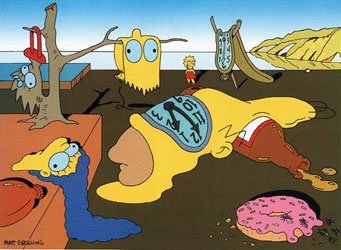
In today’s world, it seems that everything that exists in reality also exists in a virtual form. We can talk to each other in person, or talk to virtual representations of each other. We can listen to music live, emanating from physical instruments, or we can listen to an mp3, something that is pretty much intangible. This concept is a good indicator of the era that we are currently in—the postmodern era. Chapter eight of the Practices of Looking attempts to explain this postmodern era and describe its interaction with modernism.
According to many critics, postmodernism came into being in the years after 1968, in order to describe “cultural logic of late capitalism” that came in the post war years. (p 311). Postmodernism is considered to be a response to modernism, but they are often interwoven. The Practices of Looking distinguishes between the two stating that “Whereas modernity was based on the idea that the truth can be discovered by accessing the right channels of knowledge to arrive at structural and material bases, the postmodern is distinguished by the idea that there is not one but many truths and that the notions of truth are culturally and historically relative constructions.” (p 313) Overall, the main driving force behind postmodernism is authenticity.
This chapter explains how hard it is for anything to be authentic and original these days. Every story line has been done before, every song has already been written. One way that producers of media have tried to avoid being redundant is by working references to things done in the past into their own work. With the abilities presented by digital technology, it is easy to “remix” culture; bringing old ideas and combining them with newer ones. For example, the 2001 movie Shrek takes all the typical ingredients of a fairytale and combines them with multiple pop culture references to create a satire of story telling. Meanwhile, the movie continues to entertain by providing the audience with a fairytale love story. While we all have seen handfuls of princess stories thanks to Disney, we have never seen a more clever way of presenting one. When making references to other movies such as The Matrix, Shrek provides a prime example of what is known as “intertexuality”, or “the insertion of part of one text, with its meanings, into another.” (p 321). This idea important to postmodernism, where it is all about “citation or quotation both in terms of referencing other texts and in terms of putting things in quotes to indicate a kind of distancing irony.” (p 321). By making reference to another text, a link is created between the two, and when the viewer in two or more texts at a time, a deeper emotion is evoked. In many instances, there is a large gap of time between the two texts. This allows for “a re-evaluation of, and a dialogue with the past in light of the present.” (p 332). This can allow for new thoughts to be brought up about old ideas and is a very powerful tool in postmodern media.
Another important aspect of postmodernism is reflexivity. In reflexivity, the text makes reference to its own production, showing the intentions of the artist or producer in hopes of sending a stronger message. The chapter provides the example of the photography of Cindy Sherman, who operated on both sides of the lens, as model and photographer. What makes reflexivity interesting is the idea that the spectator is not on the outside looking in, but rather on the inside. Photographer Nikki S. Lee literally became one with the groups of people that she was photographing in order to get a better idea of how they really act. Lee made adjustments to how she looked on the outside to attain this feat, but according to postmodernism, surface appearance is still an important factor in truth, even though modernism may believe that the truth lies inside. Many times, the truth was not “hidden” from us, but rather we needed a new way to look for it. (p 325).
While it may be hard for some people to see the difference between modernism and postmodernism, simply understanding each concept can help in being critical of the media we are often bombarded with. The postmodern era is upon us, and as long as technology advances and people continue to be creative, there will be fresh ideas even though it seems everything has been done before.
Sunday, April 19, 2009
Wednesday, April 15, 2009
Journal #4: Why am I addicted to Facebook?
 I've had a facebook for a pretty long time. My earliest wall post came October of 2005. I remember when you could only have one profile picture; when there was no such thing as a "status"; when it really got popular; when they changed the layout the first time; when they changed the layout again. Facebook and I have been through a lot. To me, facebook is an extension of myself. It is, after all, a digital representation of who I am. One thing that drives me crazy about facebook however, is that I can’t seem to stay off it. I’ve been sitting here in the library for about an hour now, and I must have checked my facebook at least five times, always hoping for a little red notification flag to be sticking up. Nothing seems to change, yet I instinctively refresh the page just to make sure. I just can’t seem to stay away.
My friend recently gave up facebook for lent. I really don’t know how she did it. Checking my facebook is the first thing I do in the morning, the first thing I do when I get back from class, and the last thing I do before going to bed. It has become a routine part of my life. Last semester, I did a little bit of research about internet addiction and discovered that there are some psychological reasons for it. When we do log in and find a wall post or photo comment awaiting us, it is like a reward. We become like Pavlov’s dogs: we see a computer and we hope that there is a prize inside.
So is being addicted to facebook harmful? Well, I haven’t died yet. I think it is only harmful if you let it become more important than face-to-face relationships or let it completely take priority over your schoolwork. Facebook does have it’s advantages; you can keep up with friends from high school or stay up on the latest trends. I don’t think there is a cure for facebook addiction. The only thing that might put an end to this pandemic would be the creation of something better. This generation seems to be very reliant on the internet; it is how we find others to date, buy things, diagnose ourselves with illnesses, obtain our news, and keep in contact with those far away. I think it is ok to be addicted to the internet, considering it has been integrated into nearly every aspect of life.
Sunday, April 12, 2009
Ch 6 Synopsis
Nearly everything we do these days involves some sort of medium. We spend hours watching TV, surfing the web, or reading magazines. We take in so much media that it simply becomes a part of our life; we take in all this media without even realizing it. Chapter 6, “Media in Everyday Life”, outlines the ways media enters our lives and how it shapes our understanding of what goes on in the world.
In order to understand “mass media”, it is important to define what the word “mass” means. In historical medial theory, “the masses” is a word that “has been used to characterize audiences as undifferentiated groups of people, individuals who are passively accepting and uncritical of media practice and messages authored by corporations with profit motives, whose messages support dominant ideologies and ruling class and/or government interests.” (p 225) This definition of “the masses” best describes the society created in the mid-twentieth-century, when urbanization the once small-scale sense of community. As the population grew and the people moved closer together, they became an undifferentiated mass. The mass media present during this time period were radio, TV, film, and the press. Since there were not a lot of available outlets for the media, the message they were sending had to please a very large number of people. However, once the digital age took over, many things in mass media changed.
With the creation of things like the internet, digital television, and satellite radio, the media was able to aim their messages towards smaller, “niche” audiences. In a given household, hundreds of television channels can be watched and endless websites can be visited. If a person has an unusual interest, they no longer have to settle for the things that everyone else is interested in, as they can find it somewhere, thanks to the expansion of media. This model is known as the narrowcast model (p 233), which allowed for community-based programming targeted to niche audiences.
With all these new forms of media, it has become hard to distinguish which mediums are reliable. The same information can be found on a news website, a newspaper, a national news broadcast, a local news broadcast, or a news blog, yet each one is ranked differently in reliability. Factors ranging from the racial identity of the newscaster to the speed of transmission can determine how the message is taken in.
While one may think that the narrowcast model was driven by a desire to meet the needs of underrepresented audiences, television scholar Timothy Havens discovered otherwise. His studies in 2006 show that “only a few thousand professionals are responsible for the acquisition and distribution decisions of television markets around the world and that these professionals base their decisions not on audience tastes but on institutional incentives” (p 237). While media appeared to be democratizing, it was in fact coming under the control of fewer and fewer persons.
Despite all of this, the power behind what exists in media shifts hands often. Businesses and governments may regulate what is put out, the audiences determine the success of the messages. The people also have the right to make their own media, with user-generated content on the internet being one of the biggest trends today. However, it seems that it is still the businesses making the profit in the long run. Media is everywhere in our lives; it is nearly unavoidable. The more we are aware of this presence, the more we can control how it impacts our lives, an ability very important in maintaining individual lifestyles. We do not want to become one big “mass”.
In order to understand “mass media”, it is important to define what the word “mass” means. In historical medial theory, “the masses” is a word that “has been used to characterize audiences as undifferentiated groups of people, individuals who are passively accepting and uncritical of media practice and messages authored by corporations with profit motives, whose messages support dominant ideologies and ruling class and/or government interests.” (p 225) This definition of “the masses” best describes the society created in the mid-twentieth-century, when urbanization the once small-scale sense of community. As the population grew and the people moved closer together, they became an undifferentiated mass. The mass media present during this time period were radio, TV, film, and the press. Since there were not a lot of available outlets for the media, the message they were sending had to please a very large number of people. However, once the digital age took over, many things in mass media changed.
With the creation of things like the internet, digital television, and satellite radio, the media was able to aim their messages towards smaller, “niche” audiences. In a given household, hundreds of television channels can be watched and endless websites can be visited. If a person has an unusual interest, they no longer have to settle for the things that everyone else is interested in, as they can find it somewhere, thanks to the expansion of media. This model is known as the narrowcast model (p 233), which allowed for community-based programming targeted to niche audiences.
With all these new forms of media, it has become hard to distinguish which mediums are reliable. The same information can be found on a news website, a newspaper, a national news broadcast, a local news broadcast, or a news blog, yet each one is ranked differently in reliability. Factors ranging from the racial identity of the newscaster to the speed of transmission can determine how the message is taken in.
While one may think that the narrowcast model was driven by a desire to meet the needs of underrepresented audiences, television scholar Timothy Havens discovered otherwise. His studies in 2006 show that “only a few thousand professionals are responsible for the acquisition and distribution decisions of television markets around the world and that these professionals base their decisions not on audience tastes but on institutional incentives” (p 237). While media appeared to be democratizing, it was in fact coming under the control of fewer and fewer persons.
Despite all of this, the power behind what exists in media shifts hands often. Businesses and governments may regulate what is put out, the audiences determine the success of the messages. The people also have the right to make their own media, with user-generated content on the internet being one of the biggest trends today. However, it seems that it is still the businesses making the profit in the long run. Media is everywhere in our lives; it is nearly unavoidable. The more we are aware of this presence, the more we can control how it impacts our lives, an ability very important in maintaining individual lifestyles. We do not want to become one big “mass”.
Monday, April 6, 2009
Journal #3: What is Product Placement?
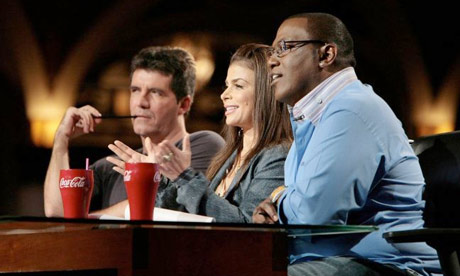
I’ve often wondered how much Coca-Cola the judges of American Idol drink. Placed perfectly in front of the judges is a glass with the Coca-Cola logo. With millions of people watching American Idol on a nightly basis, Coca-Cola gets their message across before the audience has time to change the channel during commercials. Since many advertisers know that many people simply don’t take in commercials, by placing the ads within the program, they improve their chances of success. This theory is known as product placement and can be seen in all sorts of media—books, television, video games, movies, music, etc. According to HollywoodBranded.com, “Product placement advertising is a proven method of developing brand recognition by presenting the brand’s logo, verbal mention or appearance of a product in an entertainment property.”
I’ve been watching the most recent cycle of America’s Next Top Model on a weekly basis and without fail, each episode contained some sort of product placement. When Tyra Banks lists the prizes to be awarded to the winner, she always mentions that the winner will be on the cover of Elle magazine. This concept works in the favor of both the reality show and the magazine. The magazine gets in-program exposure, while the show will get exposure to the readers of the magazine who do not already watch it.

One of the more famous product placements in the movie industry would be the service of FedEx in the 2000 movie Cast Away. Tom Hank’s character plays a FedEx employee and obtains his famous Wilson volleyball (another product placement) from a FedEx package. While FedEx neither paid nor asked for this product placement, they reported an increase in recognition in Asia and Europe, something they might not have been capable of obtaining without the connection to the movie. (Fred Smith, the CEO of FedEx, did, however get to make an appearance in the movie.)
Not only can product placement be used in the business world, but in the world of pop culture. Take Flo Rida’s song “Low” for example. The chorus of this hit song includes products such as “Apple Bottom Jeans” (a clothing company launched by fellow hip-hop artist Nelly) and “Reeboks with the straps”. These pieces of clothing may have already been staples of the hip-hop culture, but being mentioned in the song reinforces their cultural identity.
With all of the constant advertising and marketing thrown at audiences, marketers must keep finding new ways to get their products exposed. By having their advertisements take place between the commercials rather than between the shows, the likelihood of their reception increases. Product placement is a very powerful tool for marketers, and if used correctly can work even better than advertisements that audiences have already learned to tune out.
Friday, April 3, 2009
Thursday, April 2, 2009
Ch 5 Synopsis
According to Chapter Five of Understanding The Media, media cannot be fully understood unless the concept of ideology is understood. Ideology is defined as “the ideas that legitimize the power of a dominant social group or class.” (pg 157) As media has become more globalized over the years, this concept has grown in importance. Mass media allows for ideologies to be produced and circulated with ease, and when put on a global scale, it becomes an unstoppable force. In addition, ideology is an important aspect of social theory. The relationship between the audience’s social beliefs and the media is studies in ideological and discursive analysis. As ideology has been studied over the years, its definition has evolved.
The earliest definitions of ideology were called the closed and materialistic definitions of ideology. These definitions were most notably put to use by Karl Marx and later, the Frankfurt School. According to Marx, the ruling classes of capitalist societies controlled both the means of material production and the production of ideas. (pg 163) The Frankfurt School applied Marx’s understanding and applied to the mass media of the 20th Century, exploring propaganda in mass media.
The open definitions of ideology were developed by Louis Althusser and Antonio Gramsci. Althusser’s ideological state apparatus sought to prove that the media was reproducing ideology to represent capitalism in a natural and desirable way. Gramsci developed the concept of hegemony and how it is used by those with the power and means to create a consensus in society. Gramsci claims that mass media is the key source of hegemonic ideology.
Meanwhile, John Thompson’s focus is on dominant ideology, Dominant ideology by definition means that “a wider range of ideologies potentially exist within media content.” (pg 177). Thompson believed that ideological analysis is a vital part of media and communication studies. He also believes that there are three key dimensions of the communication process that should be focused on: production, content, and reception. We cannot fully understand communication if we understand all three aspects.
There are many ways to try to understand the media and apply it to our lives. Sometimes media corporations and producers take it upon themselves to try to figure out what the desired audience wants. However, this is dangerous as it creates a preferred and dominant social group. When this happens, the media is only broadcasting to the “average” person, a person who is created based on what the latest trends would be. If we can better understand the theories of ideology, we can better interpret how the media works.
The earliest definitions of ideology were called the closed and materialistic definitions of ideology. These definitions were most notably put to use by Karl Marx and later, the Frankfurt School. According to Marx, the ruling classes of capitalist societies controlled both the means of material production and the production of ideas. (pg 163) The Frankfurt School applied Marx’s understanding and applied to the mass media of the 20th Century, exploring propaganda in mass media.
The open definitions of ideology were developed by Louis Althusser and Antonio Gramsci. Althusser’s ideological state apparatus sought to prove that the media was reproducing ideology to represent capitalism in a natural and desirable way. Gramsci developed the concept of hegemony and how it is used by those with the power and means to create a consensus in society. Gramsci claims that mass media is the key source of hegemonic ideology.
Meanwhile, John Thompson’s focus is on dominant ideology, Dominant ideology by definition means that “a wider range of ideologies potentially exist within media content.” (pg 177). Thompson believed that ideological analysis is a vital part of media and communication studies. He also believes that there are three key dimensions of the communication process that should be focused on: production, content, and reception. We cannot fully understand communication if we understand all three aspects.
There are many ways to try to understand the media and apply it to our lives. Sometimes media corporations and producers take it upon themselves to try to figure out what the desired audience wants. However, this is dangerous as it creates a preferred and dominant social group. When this happens, the media is only broadcasting to the “average” person, a person who is created based on what the latest trends would be. If we can better understand the theories of ideology, we can better interpret how the media works.
Thursday, March 26, 2009
The Merchants of Cool
 Teens make up a very large part of today’s market. 32 million teens with plentiful disposable income provided for the most part by their parents creates a massive empire to the tune of $150 billion. Since this is such a huge part of the spending market, corporations find it vital to understand and recognize what is considered “cool” among today’s teens. In 2001, author and media critic Douglas Ruskoff explored how trends are tracked in the show, “The Merchants of Cool”.
Not only do teens spend a lot of money, but they also spend on lot of time taking in media content. In addition, teens are bombarded daily by thousands of discrete ads. Corporations find it very useful to market themselves to this huge teen audience. In order to do this best, they must find out what the teens would be most interested in. Companies, such as Look-Look search for a “personality” that would sell. They call this “cool hunting”. By finding out who the trendsetters are and what trends are rising up, the cool hunters can make projections are market their products in the best possible way.
Advertisers have found that teens can see straight through a campaign scheme, so instead, they have found it more effective to have their products become part of a culture. Companies, such as Sprite, have combined corporation and culture, creating a new identity without appearing to try too hard. Sprite was heavily promoted by hip-hop artists (who were paid to do so) and the soft-drink immediately entered the minds of teens via the culture, not a campaign.
Viacom, one of the big five of media corporations, make a billion dollars in profit off of their television channel MTV. MTV is comprised mostly of cheap, easy to create content. They follow what they call “the rule of cool”, by not letting their marketing show. They often do their market research by going to the homes of a typical viewer and studying them in nearly all aspects of life. They feel the more they know about their customer, the better the connection they can make with them. This ifnography study creates a portrait of their teen audience that they can then turn into content on their channel. The “Mook” and the “Midriff” represent the things that boys and girls associate with. The “Mook” can be found in programming like professional wrestling and shows like Jackass, while the “Midriff” is all about the female appearance. MTV promotes raunchy behavior, as seen on their Spring Break programming to the point where it becomes unclear who is imitating who. Is the media reflecting the real life actions of the audience or is the audience just imitating what they see in the media? This feedback loop has gotten to a point where finding an answer to this is impossible.
For me personally, this is my last year being defined as a teenager. I have pretty much grown up watching things like MTV and being the one marketed by corporations. I can defiantly see where the media has had an impact on teens. When the media portrays certain things as being “cool” they do indeed become cool. Sometimes I wonder how trends would form if it weren’t for the media, but I guess that is a world we will never get to see.
Friday, March 13, 2009
Self Portraits

This portrait represents a bunch of the products and brands that I consume.

This portrait is a little hard to see but I have three images representing media combined with a picture of me. I included a macbook (representing my use of the computer and internet), the buttons of a tv remote (representing the tv I watch), and a cell phone. Together, they make up most of the media I take in.
Wednesday, March 11, 2009

Happiness Machines, a part of a documentary series called “Century of Self”, describes how psychoanalysis has been used throughout the last century in efforts to make mass communication more effective. The documentary focused on the thoughts of two important people; Sigmund Freud and his nephew, Edward Bernays. Freud had developed a whole theory on psychoanalysis, but in his home of Vienna it was overlooked as useless. Bernays, who was working in America, however, found that he could put his uncle’s theory to good use. In fact, if Bernays had not provided money to Freud to get print copies of his works to America, they may have gone unrecognized for years more.
Bernays noted that the word “propaganda” was being received with negative connotations so he developed a new word: “public relations”. The groundwork for today’s media was laid in the early 20th century and its remnants can still be seen. He was one of the first to uncover the idea that the car could symbolize sexuality for men, a thought that still exists despite the changes to cars and who drives them over the years. Bernays’ use of psychoanalysis in public relations is best exemplified by how he was able to change the perception of female smokers.
Without the discoveries made in the early 20th century it is impossible to know what things would have been like in the mid 20th century when televisions entered the home. The media as we know it now might be complete different without the theories of psychoanalysis.
Sunday, March 8, 2009
Synopsis of Ch 3
Chapter 3 of Understanding the Media by Eoin Devereux goes into an explanation of how the media is organized. There are many different ways that media-based companies are structured, and how it is organized has an effect on what comes out of it. In order to best understand the products of media companies, it is important to have a concept of how they are organized and run.
The types of owners of the company often determine what their content is like, mostly due to the differences in editorial freedom. Different types of ownership include private, public, and non-profit. Public ownership of media producers often try to please a very large audience, with a broad range of interests. These companies are often funded by commercial activities, but sometimes work with privately owned operators. In the past, when a company was privately owned, it was controlled by a small group of people. These days, however, they are controlled by conglomerates. Non-profit companies often cater to a very small, specialized audience on a much smaller scale.
As companies merge, fewer people become in charge of larger number of media sources, and not just on a national level, but a global one. As ownership becomes more concentrated and globalized, media content appears to become more and more “dumbed down”. In addition, if the owners of a conglomeration choose to go in a certain direction, all of their subunits follow suit, leading to a decline in diversity.
Another way to describe the organization of media ownership is vertical versus horizontal integration. When an owner controls both the production and distribution of a single product entirely, it is considered vertical integration. When a single company owns a variety of smaller units of media, it is called horizontal integration. These two types of organization also impact the outcome of the media. In horizontal integration, there is a higher chance of attaining greater profits, as certain areas of the ownership may excel. In vertical integration, however, all of the company’s efforts go into one product and become reliant on its success.
The chapter continues by discussing the concept of the public sphere. The public sphere, developed by Jürgen Habermas, emphasizes the importance of public discourse in order to maintain a civic and democratic society. Since mass media is such a large factor of how people think, it is important to implement the public sphere into it. However, this becomes difficult when trying to appease a number of different audiences and ideas. One media source that overcomes this challenge is the internet. The possibilities of the internet are nearly infinite, as a user can search for literally anything in the world. While this may sound great, many internet users often overlook the “important” things and instead go for entertainment over information. The internet has the potential to be a great public sphere, but not until it can be equally accessed by anyone.
Overall, media depends on two things, who produces it, and what the consumers do with it. The organization of ownership often determines the audience being sought and the message being sent. The audience, in turn, determines how the messages affect them.
The types of owners of the company often determine what their content is like, mostly due to the differences in editorial freedom. Different types of ownership include private, public, and non-profit. Public ownership of media producers often try to please a very large audience, with a broad range of interests. These companies are often funded by commercial activities, but sometimes work with privately owned operators. In the past, when a company was privately owned, it was controlled by a small group of people. These days, however, they are controlled by conglomerates. Non-profit companies often cater to a very small, specialized audience on a much smaller scale.
As companies merge, fewer people become in charge of larger number of media sources, and not just on a national level, but a global one. As ownership becomes more concentrated and globalized, media content appears to become more and more “dumbed down”. In addition, if the owners of a conglomeration choose to go in a certain direction, all of their subunits follow suit, leading to a decline in diversity.
Another way to describe the organization of media ownership is vertical versus horizontal integration. When an owner controls both the production and distribution of a single product entirely, it is considered vertical integration. When a single company owns a variety of smaller units of media, it is called horizontal integration. These two types of organization also impact the outcome of the media. In horizontal integration, there is a higher chance of attaining greater profits, as certain areas of the ownership may excel. In vertical integration, however, all of the company’s efforts go into one product and become reliant on its success.
The chapter continues by discussing the concept of the public sphere. The public sphere, developed by Jürgen Habermas, emphasizes the importance of public discourse in order to maintain a civic and democratic society. Since mass media is such a large factor of how people think, it is important to implement the public sphere into it. However, this becomes difficult when trying to appease a number of different audiences and ideas. One media source that overcomes this challenge is the internet. The possibilities of the internet are nearly infinite, as a user can search for literally anything in the world. While this may sound great, many internet users often overlook the “important” things and instead go for entertainment over information. The internet has the potential to be a great public sphere, but not until it can be equally accessed by anyone.
Overall, media depends on two things, who produces it, and what the consumers do with it. The organization of ownership often determines the audience being sought and the message being sent. The audience, in turn, determines how the messages affect them.
Friday, March 6, 2009
Magazine Assignment

For my magazine assignment, I chose Time Magazine as my starting point. I created my own text for the cover, writing "The Newcomer" on each cover. For each cover, I put a different picture, a person, an object, and an idea. Barak Obama may be an obvious "newcomer", as he is newly president, but it was interesting to see the same text placed over a picture of a new technology (the iPhone), and a new idea movement (going green, represeneted by the lightbulb). It was interesting to see the feeling change from cover to cover. as each newcomer has a different kind of impact on our lives. Here are my three covers:


Thursday, March 5, 2009
Spectatorship and Power Relationships in Advertising

The man in this advertisement does not appear to be aware that he is the object in the photo. Because he is not making eye contact, he has not engaged in a connection of any kind. Since the man’s eyes are looking down on the bottle and the water pouring from it, the spectator’s attention is drawn there too. The man does appear to be smiling, indicating that he is enjoying pouring the water. In addition, we only see the upper half of his body, so an illusion is created because it looks like he is part of the ice structure he is building, like a metaphor for him becoming one with the water. So while he is not the direct object, he is used to help that object (the water) convey the message the advertiser is trying to get across.

Kool advertisements have always been known for making their audience feel a certain way. In this advertisement, we see two people, but only the face of one of them. We can only see the hand and arm of the man holding the pack of the cigarettes. The woman appears to be looking up to see the man in the reflection, and looking up is often an indicator that the person being looked up to is in power. By giving the man holding the cigarettes the power, the advertiser conveys the message that their cigarettes will make the viewer powerful too.

Midterm Synopsis
Whenever we look at something, it is not just the object that determines what we see. We not only look in a context of the sounds, smells, and feelings surrounding us, but in the context of how our individual brains interpret what our eyes deliver. Chapter three of Practices of Looking goes into detail about the concepts of spectatorship and the gaze, explaining their uses in understanding the psychology of looking. Spectatorship is defined as “the practice of looking” (p 102), while the gaze is “a field rather than an individual’s act of looking” (p 103). The concepts of spectatorship and gaze are used in all sorts of visual media throughout history: from classic masterpieces to current blockbuster movies.
In order to better explain this concept, Foucault used the Diego Velazquez painting “Las Meninas”, painted in 1656. In this painting, Velazquez carefully took the spectator into consideration. By placing a mirror in the scene, the viewer’s viewpoint is altered, and in effect, Velazquez also places the viewer into the scene. When the viewer becomes part of the object they are looking at, it brings the interpretation to a whole new level. While these this may have been a trick of the trade nearly 400 years ago, it is still in practice today.
The unconscious mind is very important when it comes to cinematic spectatorship. The gaze has been heavily looked at in the field of psychoanalysis, and helps to understand spectatorship and the unconscious aspects of looking. “Psychoanalysis was brought in to visual theory in order to explain more fully the idea that the subject is constituted at an unconscious, as well as a conscious level” (p 103). Christian Metz, a cinematic theorist wrote about how the minds of viewers react to watching a film. When in a dark movie theater, where the screen acts almost like a mirror, the viewers shed their own ego and identifies with the character on screen. Jacques Lacan another theorist believed “that the gaze is a property of the object and not the subject who looks. The gaze is a process in which the object functions to make the subject look making the subject appear to himself or herself as lacking” (p 122), which leads to the process of identification, and the study of how we respond to and associate with images.
The gaze has also been studied in terms of gender. Through most of history, the audiences of works of art have been men, so the artists have geared their works towards male eyes and brains. This resulted in the nude females always appearing as “objects of an active or ‘male’ gaze, and their returning looks are more often downcast, indirect or otherwise coded as passive” (p 123-124). Centuries later, this trend can still been seen in present-day advertisements.
Artists and advertisers have a knack for getting into the minds of their viewers. Through careful use of the gaze and spectatorship, they cannot only alter what we see, but how we see.
In order to better explain this concept, Foucault used the Diego Velazquez painting “Las Meninas”, painted in 1656. In this painting, Velazquez carefully took the spectator into consideration. By placing a mirror in the scene, the viewer’s viewpoint is altered, and in effect, Velazquez also places the viewer into the scene. When the viewer becomes part of the object they are looking at, it brings the interpretation to a whole new level. While these this may have been a trick of the trade nearly 400 years ago, it is still in practice today.
The unconscious mind is very important when it comes to cinematic spectatorship. The gaze has been heavily looked at in the field of psychoanalysis, and helps to understand spectatorship and the unconscious aspects of looking. “Psychoanalysis was brought in to visual theory in order to explain more fully the idea that the subject is constituted at an unconscious, as well as a conscious level” (p 103). Christian Metz, a cinematic theorist wrote about how the minds of viewers react to watching a film. When in a dark movie theater, where the screen acts almost like a mirror, the viewers shed their own ego and identifies with the character on screen. Jacques Lacan another theorist believed “that the gaze is a property of the object and not the subject who looks. The gaze is a process in which the object functions to make the subject look making the subject appear to himself or herself as lacking” (p 122), which leads to the process of identification, and the study of how we respond to and associate with images.
The gaze has also been studied in terms of gender. Through most of history, the audiences of works of art have been men, so the artists have geared their works towards male eyes and brains. This resulted in the nude females always appearing as “objects of an active or ‘male’ gaze, and their returning looks are more often downcast, indirect or otherwise coded as passive” (p 123-124). Centuries later, this trend can still been seen in present-day advertisements.
Artists and advertisers have a knack for getting into the minds of their viewers. Through careful use of the gaze and spectatorship, they cannot only alter what we see, but how we see.
Friday, February 27, 2009

Monday, February 23, 2009
Medium is the Massage Remix
For my "Medium is the Massage Remix" I plan to explore the medium of the internet, more specifically, user-generated websites. In my remix I plan to use images to represent how the internet is used to express the user. My vision involves a computer screen containing about 8 different websites that primarily use content created by the user. Laid over all of this, will be a finger print, representing the individual factor and force we have with each of these sites. Not only does this medium shape us, but we shape it as well, which makes for an interesting concept.
Monday, February 16, 2009
Marshall McLuhan
According to Marshall McLuhan in Understanding Media: The Extensions of Man, "the Medium is the Message". By this, he means that the message that is being communicated is not actually the content, but the medium. In the first chapter of this book, McLuhan explains this theory: "Many people would be disposed to say that it was not the machine, but what one did with the machine, that was its meaning or message." (pg 23). For example, one important technology of today's world is the internet. According to McLuhan's theory, the message being communicated is not just the physical webpages, but the ideas being expressed there. The things that people do with the internet, such as posting pictures or videos, are the content, and the feelings or ideas conveyed would be the message. It is not just each individual picture or website that convey all communication, it is all of the internet put together that comprise the whole message. In conclusion, McLuhan's theory on understanding the media may not be the easiest to understand, but it explains a whole new way about thinking about communication.
Subscribe to:
Posts (Atom)